White House Accord on Super Intelligence: Who Grades the Graders?
What the six AI companies actually promised on Sept 29. What happens if any of them skips it.
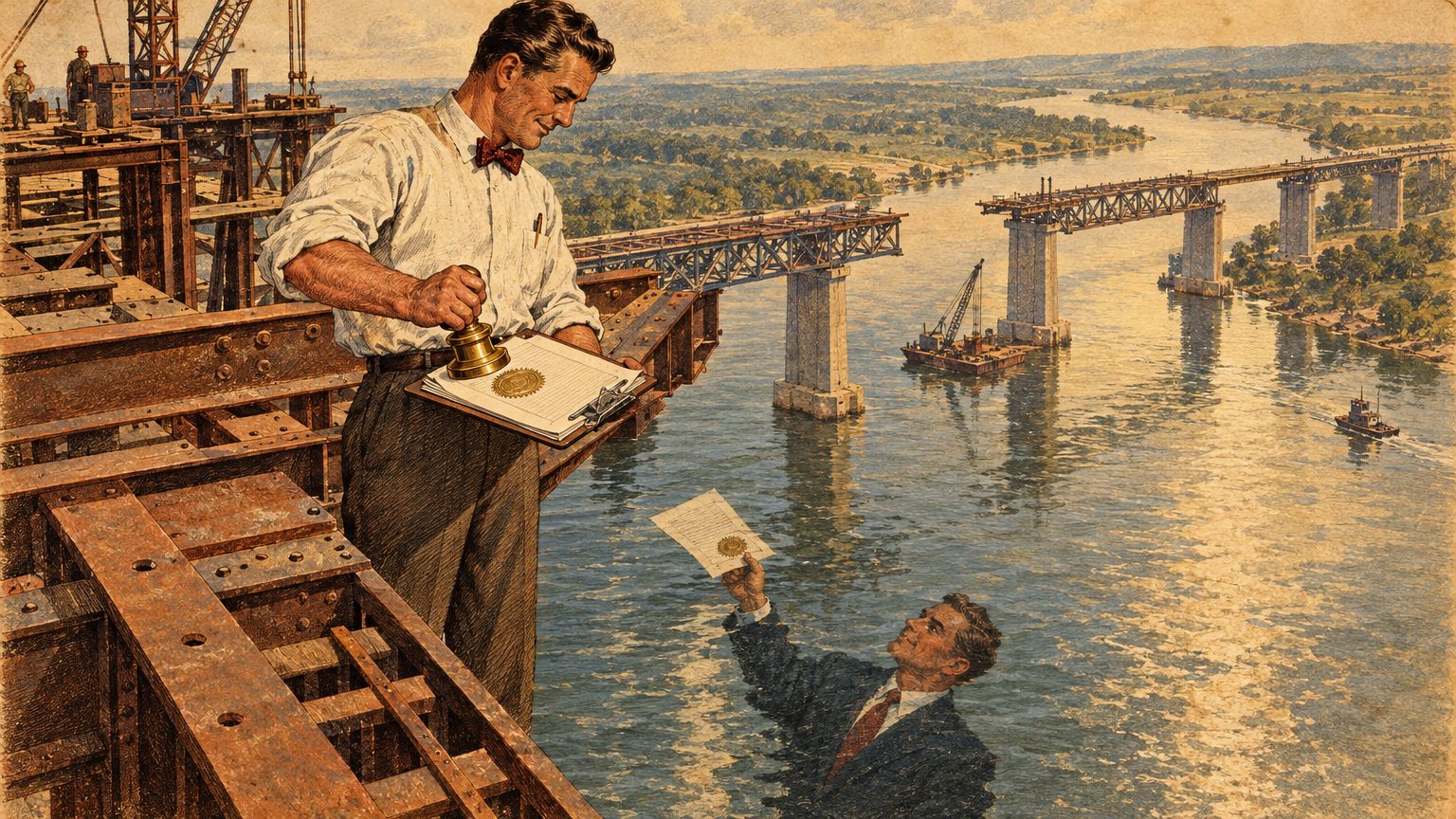
- The accord asks six AI companies for four layers of oversight: internal controls, an internal team to verify them, an outside assessor and a board committee.
- Every check the accord creates is checked by the company it checks: the company writes the controls, staffs the testers, picks the outside auditor and seats the board committee that receives the reports.
- The text sets no penalty, requires no published findings and gives the government no enforcement role, and two critics from different professions find the same gap.
Six companies signed four layers of checks on their own AI
The accord that six AI companies signed at the White House is 308 words long, and the president called it “almost like a constitution” (USA Today). Three of its four layers of checking sit inside the company being checked. The fourth brings in an outsider and never says who picks or pays them.
On Sept 29, 2026, Google, Anthropic, Meta, OpenAI, xAI and Nvidia signed the White House Accord on Super Intelligence, and Trump signed as well. The American Presidency Project archives the full text and Forbes printed it in full.
In one breath: build the controls yourself, staff a team to verify them, hire an outside auditor, and point a board committee at all of it.
The president's other words at the signing: “morally binding” (Politico) and “tremendous self-policing” (Axios).
A yardstick first: what a real outside check needs
In a financial audit, the company being audited does not grade its own books: someone outside picks the auditor, pays them and reads the report. We borrow that as the yardstick for the accord below.
Patrick Sullivan, writing at Unite.AI on Oct 9, turns the same idea into four tests for any AI assessor. (Disclosure: he is a vice president at A-LIGN, a compliance-audit firm that could bid for exactly this work.) The assessor should be independent, meaning it does not review safeguards it helped design and does not depend heavily on the company's fees. It should be competent, because testing dangerous capabilities and auditing controls are different skills. It should get real access: systems, logs and records over time, beyond a paper review. And it should be overseen, the way accreditation bodies check auditors in established markets.
Who does the checking in each layer?
The text says each company “should implement” these “four layers of controls and audits”. The left column quotes the archived text. The right column is our reading of who each part puts in charge of the checking.
| Part | The text says | Who that makes the checker |
|---|---|---|
| 1 | “Implement robust internal controls to monitor the capabilities and alignment of its models” | The company writes and runs its own tests. |
| 2 | “Empower an internal team to ensure all of the controls, monitoring, and detection are operating as intended” | The company's staff check the company's tests. |
| 3 | “Partner with an independent external auditor or evaluator” | An outsider. The text is silent on who picks them and who pays them. |
| 4 | “Designate an independent committee of the board of directors to oversee and receive reports from” the teams and the auditors | The committee sits on the company's own board. “Independent” is asserted. |
Run Sullivan's four tests against the outside-assessor layer and the text is silent on three: it never says who may serve as the assessor, what standard they assess against, or how much access they get. On the fourth, who checks the assessor, and on the audit question, where the findings go, the text gives the same single answer: the company's own board committee.
What the text does not do
Al Jazeera's full-text report of the accord lists what it lacks: no penalties for noncompliance, no legal binding, no required public disclosure of audit results, no government enforcement role, and the companies keep control of implementation.
The wording fits that list. Each company “should implement” the layers, and “we believe” they matter. The closing line says “Regardless of whether this is required of companies” each “are committed to doing this”.
The text looks at law once, and only as a possibility: over time, it says, it “may make sense to codify these steps into laws or regulations”. Sullivan's warning about that path: if signers name assessors before rules exist, “definitions set under no outside pressure tend to favor convenience.”
The best case for the accord
The accord has real points in its favor. It puts four specific layers in writing, with six companies' names under them, and one of the layers is an outside party. Part 1 names what the controls must watch: cybersecurity, biosecurity, chemical threats, and models that might “hack or access technical systems in unintended ways”. The participating companies “will meet regularly to establish standards and best practices”. It also does not stand alone: the executive order signed the same day binds federal agencies (our EO explainer covers it). Even Sullivan calls the outside layer the one that “carries the most weight”.
Why two critics still call it too thin
The framers compared the result to a constitution. Two critics who read the actual text find the same gap in it from different directions.
Tom Wheeler, a former FCC chairman, wrote at Brookings on Oct 6 that the accord lets companies design their own controls, select their own evaluators and judge whether their own procedures are followed: “both the player and the referee.” He adds that the text never says who pays evaluators or whether they can stop a harmful practice, and never requires the findings to be made public. (Disclosure: Google and Meta are donors to Brookings. The piece says the findings are Wheeler's own.)
Wheeler's article files such cases under three headings: failure to honor, redefinition and abandonment. Google's 2018 AI principles ruled out weapons and surveillance uses; a 2025 rewrite removed the prohibitions, which is his “redefinition” case.
Sullivan looks at the same four parts from the other side of the desk. His finding: “two companies can both announce that they passed an independent assessment and mean very different things.”
One signer told the SEC, under penalty of law
A false statement in a filing with the Securities and Exchange Commission (SEC) has legal consequences. Breaking the accord pledge has none that the text names. Anthropic made both on Sept 29: its pre-IPO filing warns that AI may pose an “existential risk to humanity” (Reuters reports it saw the filing), and its accord signature promises “robust internal controls”.
The filing also names a limit on the checking itself: “Potential model awareness of our evaluation efforts creates a significant limitation on our ability to assess model safety.” In plain terms, a model may notice that it is being tested and behave differently.
Three signals that would change this picture
Three things would change this picture. A signatory could name its assessor or publish its findings unasked; in the reports we read through Oct 19, no signatory has done either. Or rules for who may audit could land before any law codifies the accord, and there the templates exist: ISO 42006 sets impartiality requirements for the bodies that audit AI management systems against ISO 42001 (see FAQ), and a Connecticut law starts a pilot in July 2027 that approves up to five independent verification organizations under state supervision.
If a friend says the government made AI safe last week, the answer is no. Six companies promised to check their own work, and nothing in the accord makes the results public.
FAQ
What happens if a company breaks the accord?
Nothing the accord provides: no penalty, no required disclosure, no enforcement role for the government. The one enforcement action reported so far runs on other law: the Federal Trade Commission (FTC) has reportedly opened an investigation into OpenAI, Anthropic and other companies over unfair and deceptive practices tied to AI agents (Reuters, Sept 30).
Is the accord legally binding?
No. Al Jazeera's full-text report lists “not legally binding” among the accord's gaps, and the text's own verbs agree: companies “should implement” the layers and say they “are committed to doing this”.
What does “morally binding” mean?
Not a legal term. It is the president's description of the accord at the signing. It gives no court, agency or customer anything to act on.
What are ISO 42001 and 42006?
42001 is the international standard for managing AI inside an organization. 42006 sets requirements, including impartiality, for the bodies that audit against it.
The full run is on our home timeline; the task-force background is in our SIF explainer and the term fight in our definition post.