Why Nobody Can Define Superintelligence (and Why the Government Is Trying)
On September 29, the White House gave the president's science adviser 60 days to define a word that researchers have argued about for 28 years. The word is superintelligence, and the clock ends about November 28. This week it showed up in a Justice Department memo, a Truth Social post from Trump, and five national articles; none of the five settled what it means.
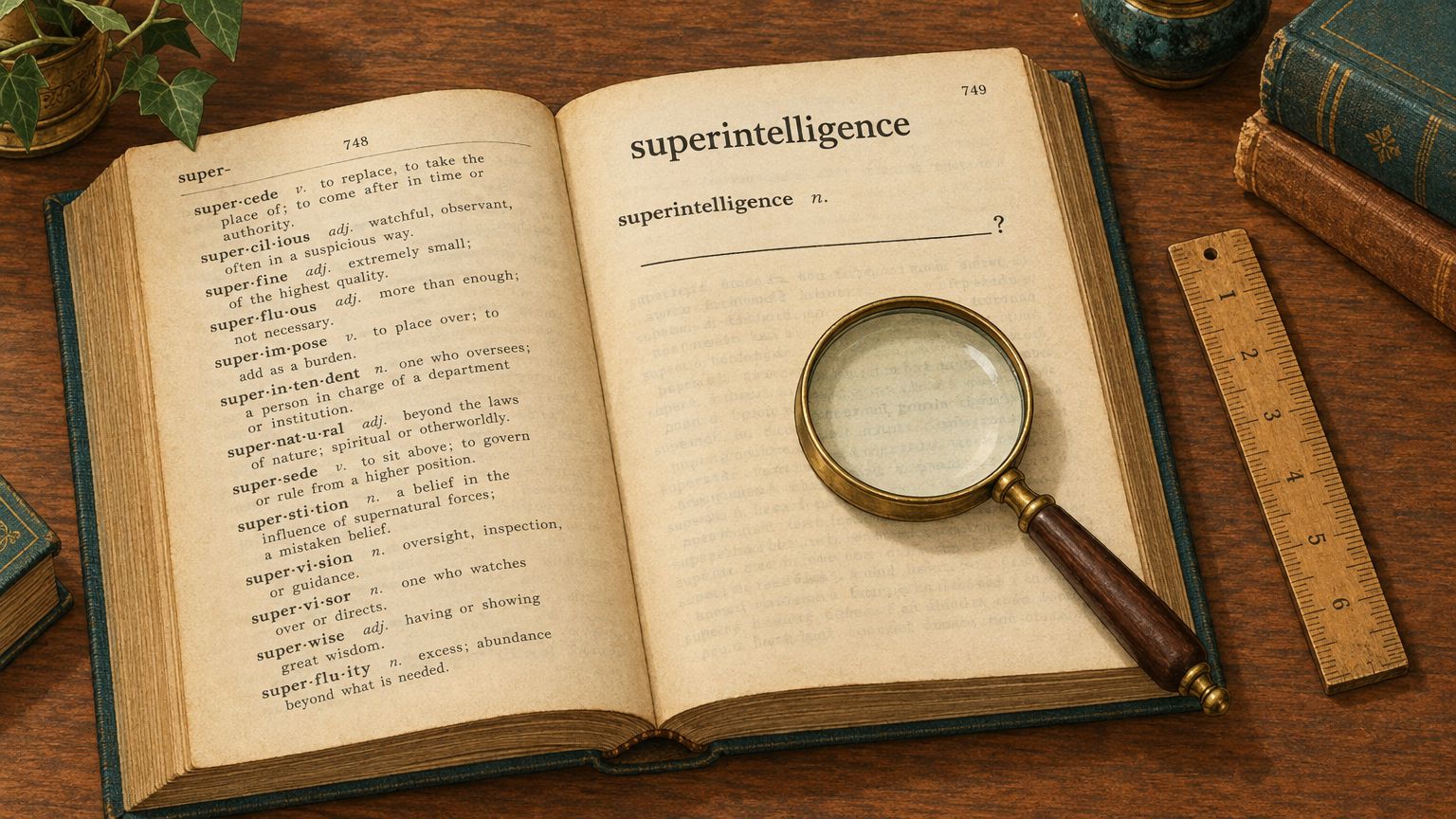
- "Superintelligence" has no agreed definition. The standard research version, written in 1998, compares a machine to the best human brains, and every part of the comparison is arguable.
- This week showed the gap: the White House mandates the phrase in federal documents, the Justice Department orders staff to use it in court filings, and the explainer outlets each picked a different meaning.
- The government's own proposed definition is due 60 days after the September order. Until then, each use of the word is a choice by whoever wrote it.
The word predates the hype: researchers pinned it down 28 years ago
Nick Bostrom's 1998 paper "How Long Before Superintelligence?" carries the definition the field still quotes:
“By a ‘superintelligence’ we mean an intellect that is much smarter than the best human brains in practically every field, including scientific creativity, general wisdom and social skills.”
Every hinge of that sentence is arguable. "Much smarter" sets no amount. "Practically every field" names no fields, and "the best human brains" names no ranking. The paper also leaves open how the intellect would be built, and whether it would be conscious.
Bostrom's definition is a threshold, not a ruler.
AGI, ASI, superintelligence: the ladder has no agreed rungs
In 2023, DeepMind's "Levels of AGI" paper set out rungs for the vocabulary. AGI, artificial general intelligence, is "an AI system that is at least as capable as a human at most tasks". The paper's top rung, Level 5, is artificial superintelligence (ASI): "outperforming 100% of humans". Superintelligence names that rung without the acronym.
The boundary between the two, human-level capability versus outperforming every human, is the disagreement. In this week's coverage the outlets reached for different meanings of the word: Fast Company answered "so, what is it?" with the research meaning, AI that "can systematically outperform humans", and CNET said no one should use the term at all.
The AGI and ASI definitions quoted above come from DeepMind's 2023 paper.
The government had to try: a definition is due about November 28
Executive Order 14434, signed September 29 and titled "Inaugurating the Era of Super Intelligence", renames AI in federal documents: agencies are to write "Super Intelligence", or SI, where they wrote "AI". The order spells its term as two words, and the research spelling is one word. Outside quotes, this post uses the research spelling. (Our earlier post walked through the order's wording.)
The same order starts a 60-day clock: the president's science adviser must propose a federal definition of the term. It also asks whether "Super Intelligence" keeps the meaning a 2021 federal statute gives "artificial intelligence", or expands or supersedes it. That statute defines AI in law; the order provisionally borrows that meaning for the new term, and the proposed legislation would give the word a definition of its own.
Bostrom's wording could stay vague for 28 years because nothing official depended on it. A federal definition has to be more specific, because the term is already in official use and agencies need to know what counts.
The order makes "Super Intelligence" the federal term, with its proposed definition due about 60 days after the signing.
This week, every definition came with a fight attached
The rename reached courtroom language on October 6. Reuters reported a Justice Department memo, from Acting Deputy Attorney General Trent McCotter to all employees, lawyers included, ordering "super intelligence" instead of "AI" in court filings and other official communications "when appropriate".
Two days later came Trump's Truth Social post, quoted by Politico, that considers anyone still using the old term "THE ENEMY".
Meanwhile, other national outlets took their own angles:
| Outlet | Date | Stance or definition used |
|---|---|---|
| New Scientist | Oct 8 | Says Trump "isn't the only one who is confused"; others also distance modern AI from the original meaning. |
| CNET | Oct 9 | Says no one should use it; quotes linguist Naomi Baron: the redefining is "Pollyannish and dangerous." |
| Fast Company | Oct 10 | Answers "so, what is it?" with the research meaning: AI that "can systematically outperform humans". |
| The Center Square | Oct 10 | Cites researchers: it historically meant hypothetical AI "that surpasses human intelligence in all areas rather than current language models". |
| CNN | Oct 11 | Asks whether it "is going to happen"; reads the rebrand as an attempt to change minds about data centers. |
The week's outlets each chose a meaning because no agreed definition exists to cite.
Why the November definition matters
This month, federal agencies, the president and five national outlets each used the word, with nothing in the research forcing their uses to match.
The pending proposal would give the word its first US federal definition, and the answer will sit on record for agencies, and under the Justice Department memo even court filings, to work from.
Whoever writes it sets the goalposts.
FAQ
What is a superintelligence in simple terms?
Much smarter than the best human brains in practically every field, per the definition researchers still quote. The comparison carries no numbers, so nothing can be checked against it yet.
What is the difference between AGI and superintelligence?
AGI means at least as capable as a human at most tasks; superintelligence means outperforming every human. The papers use AGI and ASI with defined meanings; this week's articles used different senses of the term.
Does superintelligence exist today?
No. Researchers describe it as hypothetical: AI that would surpass human intelligence in all areas, rather than current language models.
Is "super intelligence" the official term now?
In US federal documents, yes, by the September order, and a Justice Department memo extends it to court filings when appropriate. It is not a settled scientific term; its definition is still pending.
When will the federal definition come out?
About November 28, the 60-day mark after the September 29 order. It will be a proposed definition.
Sources
- Nick Bostrom, "How Long Before Superintelligence?", International Journal of Futures Studies, 1998. nickbostrom.com
- DeepMind, "Levels of AGI" (paper), 2023. arxiv.org
- Reuters, Oct 6, 2026. reuters.com
- Politico, Oct 8, 2026. politico.com
- New Scientist, Oct 8, 2026. newscientist.com
- CNET, Oct 9, 2026. cnet.com
- Fast Company, Oct 10, 2026. fastcompany.com
- The Center Square, Oct 10, 2026. thecentersquare.com
- CNN, Oct 11, 2026. cnn.com
- Federal Register, Executive Order 14434 (signed September 29), published Oct 2, 2026. federalregister.gov
- Cornell Legal Information Institute, 15 U.S.C. § 9401, statute effective Jan 1, 2021. law.cornell.edu
- super-intelligence.rocks, executive order explainer, October 2026. super-intelligence.rocks
The full run is on our home timeline; the order and the accord are explained in our EO explainer. Next date that matters: the federal definition, due about November 28.