Executive Order on Super Intelligence: What Trump Signed and What Six CEOs Agreed To
On paper, your chatbot is now "Super Intelligence." Two documents came out of Washington on September 29: an executive order on Super Intelligence that rewrites what the government calls AI, and a voluntary accord signed by six companies that compete for a living. Here is what each one actually does.
- Executive Order 14434 tells federal agencies to write "Super Intelligence" or "SI" instead of "AI" in their own documents, and starts a 60-day clock for a proposed federal definition of the term, due about November 28.
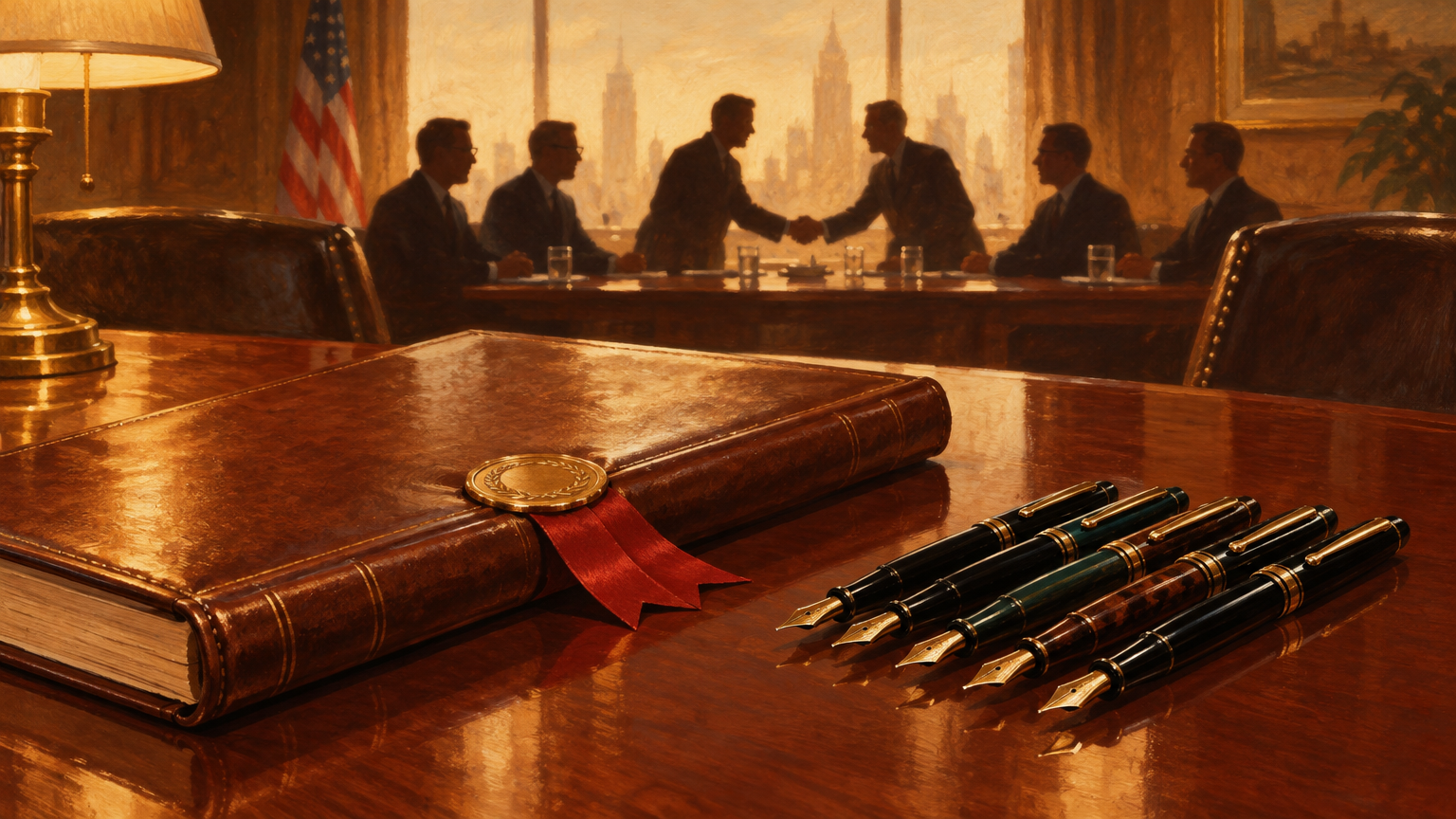
- Six companies signed the White House Accord on Super Intelligence: internal controls, independent outside audits, board-level review of the results. Trump called it "morally binding."
- Neither paper changes what the technology can do. The definition due in late November is the part worth watching.
- China did not adopt the term and has had binding AI regulations since 2022. The two countries set up a dialogue, next exchange due by November 2026, but no shared rulebook. The EU's AI Act is binding law with fines up to 3% of global turnover.
- Slowing down alone is hard because the race is close: Stanford's AI Index puts the top US model 2.7% ahead of China's best, and Franklin Templeton says neither side can afford to stop first.
What the executive order changes
Executive Order 14434, "Inaugurating the Era of Super Intelligence," directs federal agencies to use "Super Intelligence" and "SI" in place of "Artificial Intelligence" and "AI" in official correspondence, public communications, websites, reports and policy documents. It binds the government's own paperwork, not private companies, and only where the law allows: the order applies its instructions to the maximum extent permitted by law.
The rename is already visible. NIST, the federal standards agency, says on its super intelligence page that it is updating its communications to the new term "as directed," and its standards center now runs under new initials: CAISSI, the Center for Advancing Innovation and Standards for Super Intelligence.
It has limits. Section 2(b) leaves previously issued regulations, presidential actions, contracts, grants and historical documents saying AI.
The order's one real deliverable is a proposed federal definition of "Super Intelligence," due from the president's science and technology assistant within 60 days, about November 28.
So what does the new word mean? Section 3 of the order answers by pointing back at the old one:
Sec. 3(a): "For purposes of this order, and except where otherwise provided by law, the terms 'Super Intelligence' and 'SI' mean the technologies and systems encompassed by the term 'artificial intelligence' as defined in section 9401(3) of title 15, United States Code."
That cited law is section 9401(3) of title 15, on the books since 2021. It defines artificial intelligence as "a machine-based system that can, for a given set of human-defined objectives, make predictions, recommendations or decisions influencing real or virtual environments." Under the order's own definition, Super Intelligence covers whatever that statute already covered.
What the CEOs actually signed
The White House Accord on Super Intelligence is a voluntary pledge with four layers: internal controls, an internal team to oversee them, independent outside auditors, and an independent board committee to review the audit results. The companies signed on September 29, the same day as the order, and The Hill counted the signers:
| Company | Signer |
|---|---|
| Anthropic | Dario Amodei |
| xAI | Elon Musk |
| OpenAI | Greg Brockman |
| Sundar Pichai | |
| Meta | Mark Zuckerberg |
| Nvidia | Jensen Huang |
Five of the six are their companies' chief executives. OpenAI is the exception: its president, Greg Brockman, signed the accord.
The accord is voluntary, with no penalty for a company that fails to comply. The published coverage also leaves the mechanics open: none of the reporting specifies what the audits will examine, who chooses the auditors, or how often they happen. What is specified is what the accord does not do. It does not require companies to publish the audit results, it gives the government no enforcement role, and each company keeps control over how its own safeguards are implemented.
Trump called the accord "morally binding"
The most quoted description came from the president. At the September 29 signing, Trump told the executives there is "going to be a tremendous self-policing aspect" to the deal, per Al Jazeera, and called it "morally binding" while conceding it is not legally binding, per the Washington Examiner. The Examiner also reports that he compared the arrangement to a constitution.
What happens if a signer skips an audit? No lawsuit follows: the accord creates no legal duty. The check is public. These commitments were made on the record, alongside the president, and a company that promised independent audits and then skipped them would have to explain the promise it made in front of the cameras.
The accord does hold one forward-looking line. Over time, it says, it might "make sense to codify these steps into laws or regulations."
Does China do something similar?
No. China did not adopt "Super Intelligence," and it has had binding AI regulations since 2022.
China's foreign ministry said it "attaches importance to the US side's position and respects the US side's wording," per the Straits Times. Respecting a word is not using it: China's own readout calls the new mechanism the China-US AI Dialogue.
The Trump-Xi summit did produce machinery. The White House fact sheet sets up a US-China Super Intelligence (SI) Dialogue and a "bilateral communication channel for SI incidents," and says "The next exchange will occur by November 2026," per the Korea Times. It sets up no shared rulebook. Trump said a joint venture with China on safety would be "giving away secrets," per the BBC.
China already has binding rules. Carnegie says that "In 2021 and 2022, China became the first country to implement detailed, binding regulations on some of the most common applications of artificial intelligence." They include a mandatory algorithm registry (March 2022) and synthetic-media rules with watermarking (January 2023). The White House accord, by comparison, is voluntary with no penalty.
What Europe makes of it
Europe regulates general-purpose AI with a binding law, the AI Act, and fines reach 3% of global annual turnover.
Since August 2025, makers of general-purpose models must document how their models work, respect copyright and publish training-data summaries. Per the same Euronews report, the Commission's AI Office can demand information, run its own evaluations and order a model restricted or withdrawn from the EU market. Fines reach 15 million euros or 3% of turnover, whichever is higher.
Europe also has a voluntary Code of Practice, 60+ pages that sit under the Act. Per EUObserver, OpenAI, Anthropic and Google signed it. Meta, xAI and Nvidia did not, even though all six signed the US accord. So three of the accord's signers have also accepted a longer voluntary code in Brussels, one that operates beside enforceable law.
EU tech chief Henna Virkkunen said the EU "will keep pushing for global AI safety rules" despite US resistance, and the EU backs an AI safety body led by Finland and Norway and signed by 20+ countries.
Why nobody slows down alone
Stanford's AI Index puts the best US model only 2.7% ahead of the best Chinese one, and Trump has rejected a pause.
Stanford's AI Index, comparing the top US model with the top Chinese model, says that "As of March 2026, the top U.S. model leads by 2.7%," "with a gap that fluctuated over the past year while remaining in the single digits." A company or country that pauses alone hands a lead that small to the other side. Franklin Templeton, an investment firm, puts it this way: "Neither side can afford to stop first," and the likelier outcome is that "everyone keeps running, while spending more to make the race safer."
Dario Amodei, who argued for slowing down in a September essay that drew replies from Sam Altman and Elon Musk, per CNBC, named the obstacle: "Global pacing will require cooperation with China... any agreement must either have ironclad verifiability, or must be limited enough that defection would not be militarily existential." Published reporting on the accord describes audits of each signing company's own safeguards, and no step for checking a rival country's labs. Coordinating a slowdown also carries legal risk at home: four consumers have filed a federal antitrust suit against Anthropic, OpenAI, Google and xAI over an "illegal deal to slow the pace of AI development," per NPR.
Trump, rejecting a pause, said "the only one that is happy about it is China" and that "Whoever wins superintelligence wins." In China, the state newspaper Global Times called the slowdown pitch a "Cold War playbook", which is one newspaper's view, not government policy. All six accord signers are American companies, so even a voluntary slowdown by them would leave China's labs untouched.
Super intelligence is a word researchers keep for something nobody has built
Researchers use "superintelligence" for a system that does not exist yet, which is why the government's choice of word is odd. Per our Sept 29 explainer, AGI, artificial general intelligence, is the hypothetical system that matches human ability across the board: any task a person can learn, it learns too. Superintelligence is the step above, a mind that exceeds the best humans in every field at once. The first is debated. The second has never existed.
The rename started with the September 22 UN speech arguing that "artificial" makes intelligence "sound fake," and that US documents would change to "super." The order is where that promise landed. Our timeline of the rebrand follows each step.
The next date is about November 28, when the proposed federal definition is due. The order explicitly asks whether Super Intelligence should keep meaning what the 2021 statute means, or whether the new definition should expand on it or supersede it. If it expands, the government will have given the word a legal meaning of its own, and the definition will deserve the same close reading as the order.
FAQ
What is the White House Accord on Super Intelligence?
A voluntary agreement signed on September 29 by Anthropic, xAI, OpenAI, Google, Meta and Nvidia, covering internal controls, outside audits and board review.
Is the White House Accord legally binding?
No. Trump conceded it is not legally binding and called it "morally binding."
What does Executive Order 14434 do?
It changes the vocabulary of federal agencies' own documents from "AI" to "Super Intelligence" or "SI," and orders a proposed federal definition within 60 days. Private companies are outside its scope.
Does the government still use the term AI?
In places, yes. Section 2(b) leaves existing regulations, presidential actions, contracts, grants and historical documents as they are, and statutes sit outside the order's reach.
Does China use the term Super Intelligence?
No. China's foreign ministry said it respects the US side's wording, but China's own readout calls the mechanism the China-US AI Dialogue, and its AI rules are binding regulations.
Is there a US-China super intelligence agreement?
A dialogue and an incident channel, with the next exchange due by November 2026. It is not a safety pact: Trump has said a joint venture would mean "giving away secrets".
Is Europe doing the same thing?
No. The EU AI Act is binding law with fines up to 3% of global annual turnover, and its voluntary code of practice sits underneath the law.
What is the difference between AGI and super intelligence?
AGI matches human ability across tasks; superintelligence would exceed the best humans in every field at once. Our explainer has the full comparison.
New here? Start with the full story: how AI became Super Intelligence, minus the shouting →