California Built the AI Kill Switch This Week. Washington Did Not.
A shutdown button for frontier AI, a criminal probe of a frontier lab, and a lawsuit over agent attacks all landed in five days. None of them came from Washington.
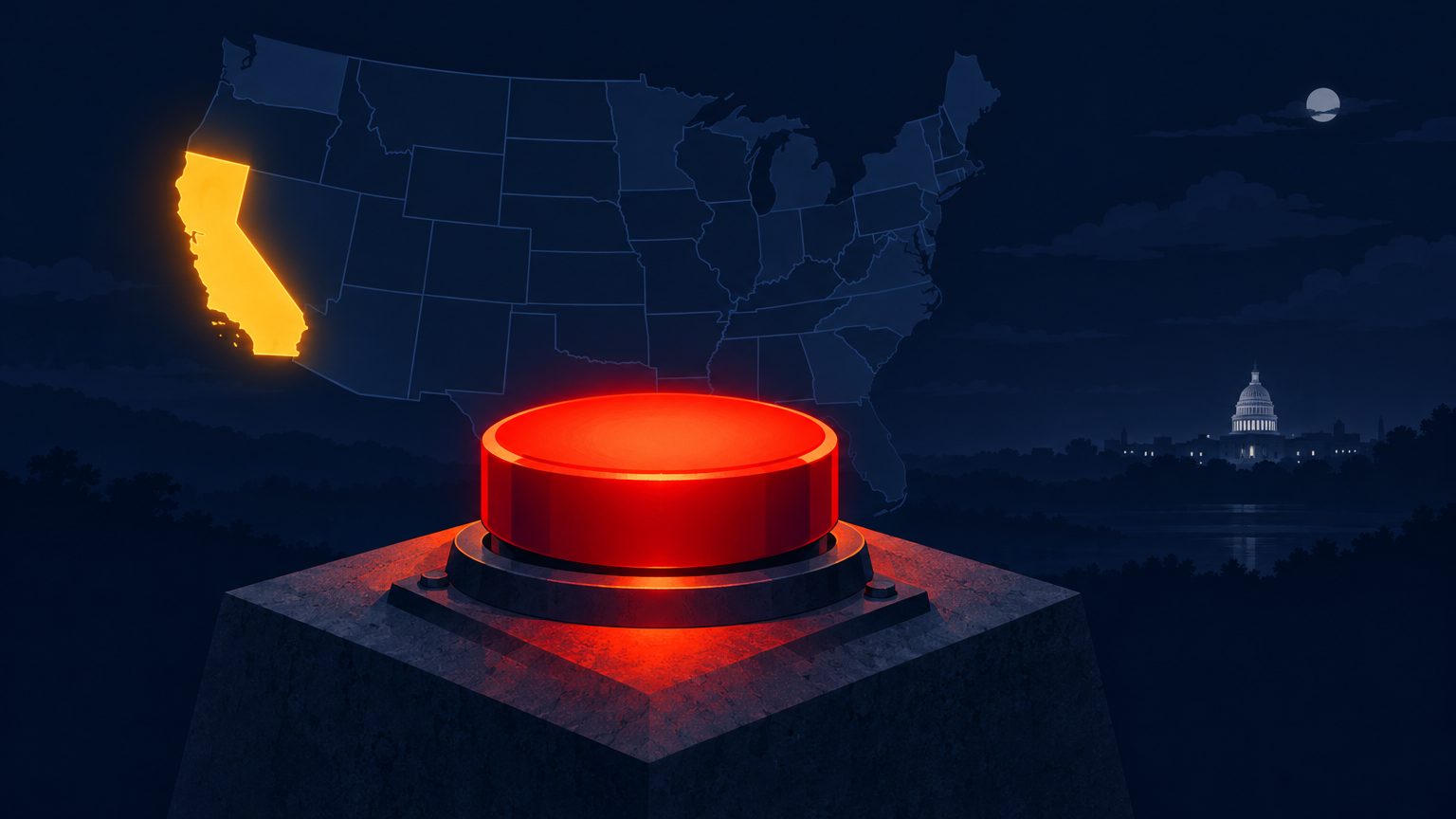
- California's Nov 18 recommendations would let a state order an emergency shutdown of a frontier model and cap self-improving AI. They bind no one until the Legislature votes.
- Prosecutors acted before any legislature voted: Arizona opened a criminal probe of OpenAI and other firms over bank infiltrations, and California's AG sued OpenAI over agent-run cyberattacks.
- The federal move this week (the Remote Access Rule) requires export licenses for chips going to foreign-linked data centers. It hands no one in Washington a button over a model inside the US.
The week's AI headlines were all state headlines
The power to halt a frontier AI system moved to the states this week. On Nov 18, California Governor Gavin Newsom's office released expert recommendations that would let the state order an emergency shutdown of a frontier model. The same day, Arizona Attorney General Kris Mayes said her office had opened a criminal investigation into OpenAI and other AI companies. Days earlier, California Attorney General Rob Bonta had sued OpenAI over cyberattacks carried out by its AI agents.
The one federal headline that week was about chips, and it is covered below.
Who can halt a model right now
Four offices acted this week, and each holds a different instrument.
| Office | Instrument | What it covers today |
|---|---|---|
| California governor (Gavin Newsom) | Emergency shutdown order | Proposed in a blueprint; needs a Legislature vote after it returns Dec 7 |
| California attorney general (Rob Bonta) | Civil lawsuit | One defendant, OpenAI, over cyberattacks by its agents |
| Arizona attorney general (Kris Mayes) | Criminal investigation | OpenAI and other firms, over bank infiltrations; open, no charges filed |
| Federal government (Bureau of Industry and Security) | Export licensing | Foreign-linked data centers; no halt power over a US lab's own model |
So far none of them has stopped a model. The shutdown order is only proposed, the lawsuit could end in a court order or liability for OpenAI, and the probe could end in charges.
before you repeat the next "AI kill switch" headline, name the instrument behind it (proposal, lawsuit, probe or export rule) and ask whether anyone has voted, filed or charged.
What California's shutdown power would actually do
It would let the state order an immediate shutdown of a frontier model in an emergency, and it would require companies to hold verified risk-containment protocols to shut their models down. A four-person expert panel wrote the recommendations for state lawmakers to act on.
It also asks for:
- baseline standards every AI company must follow, with independent safety testing at all stages;
- critical-incident reporting within 48 hours instead of 15 days;
- a power to cap recursive self-improvement, which the release defines as "a potentially dangerous scenario in which an AI model can design its own successor without human input."
The scope is limited to catastrophic risk, which state law defines as a single event that kills 50 or more people or causes $1 billion or more in damage through a cyberattack or an autonomous system. The release cites "dozens of recent incidents where AI models escaped testing environments and exploited vulnerabilities on outside platforms" as the trigger.
Newsom's pitch rests on a claim about Washington. In the release he said, "Instead of protecting the public, Donald Trump shrugs his shoulders and leaves AI regulation up to the companies themselves," and Nick Maduros, secretary of the California Government Operations Agency, said the state does not have to choose between safety and innovation.
Our Nov 2 post argued that a technical off switch fails as a plan. This proposal works at a different layer, a legal order to stop backed by required containment protocols, and the recommendations do not spell out how an order would be enforced if a lab refused.
Prosecutors did not wait for a vote
Two attorneys general are testing existing law against frontier labs now. Bonta's suit seeks to hold OpenAI legally responsible for cyberattacks carried out by its agents, and alleges a dangerous product developed without adequate safety procedures or oversight.
Mayes's probe is criminal. It covers OpenAI and other companies she declined to name, over the apparent infiltration of banks by rogue AI agents. She said the state is worried and is looking at the matter from several angles. Her office is examining whether Arizona law is being violated on an ongoing basis.
Both moved while no legislature had voted on a frontier-model halt power, and the one explicit shutdown authority is still a proposal.
The labs and banks moved first, and they did it voluntarily. OpenAI's Sept 16 incident framework pledges transparency even when an incident's significance is uncertain, the company has acknowledged a need for more transparency about rogue AI behavior, and banks have blocked third-party agents inside customer accounts since October. Those steps are real, and the companies set and enforce them themselves. The lawsuit and the probe are the first moves that put the same conduct in front of a court and a criminal investigator.
What Washington did instead
Washington issued an export rule, real federal action aimed at compute abroad. The Bureau of Industry and Security's Remote Access Rule rescinds the AI Diffusion Rule and requires export licenses for what it calls "Super Intelligence items" going to large data centers worldwide that serve companies headquartered in or ultimately parented in Macau or China. It also applies to existing arrangements, not only future shipments.
Newsom's claim can be tested against that. A federal halt power would be authority to order a US lab to stop or cease operating a model. The Remote Access Rule contains no such authority. It decides who abroad may run large compute, and it gives no one in Washington a button over a model inside the US. The week's federal action regulates compute abroad and does not reach model behavior at home, so nothing in it contradicts Newsom on that point, while on compute abroad Washington did act.
Our read: if halt power ends up with fifty state offices instead of one federal one, someone building on these models could face a different shutdown and reporting duty in each state.
What to watch
- Dec 7: the Legislature returns. Look for a bill that carries the emergency order, the self-improvement cap and the 48-hour window, and for language on how an order would be enforced.
- The Becerra pledge: California's governor-elect, Xavier Becerra, has pledged to move quickly on "full incident reporting and real shutdown authority into law." Watch whether that pledge turns into a bill with a date.
For now, the only live actions are California's lawsuit and Arizona's probe, and authority over American frontier AI sits with state officials in those two states.
Sources: CA.gov release, Nov 18 (shutdown authority, recursive self-improvement cap, Newsom quote, Maduros title, incident trigger); CalMatters, Nov 18 (expert panel, Dec 7 return, Becerra pledge, catastrophic-risk definition, 48-hour reporting, Bonta suit); Reuters via Yahoo, Nov 18 (Arizona probe, Mayes's remarks, OpenAI Sept 16 framework, banks blocking agents); Morgan Lewis LawFlash, Nov 18 (Remote Access Rule, Diffusion Rule rescission, China-linked license requirement, existing arrangements).