Proof Indigestion: OpenAI's 722 Papers. Who Checks Them?
Machines can now produce proof-shaped manuscripts by the hundred, and the three headline results show how unevenly anyone is checking whether they are proofs.
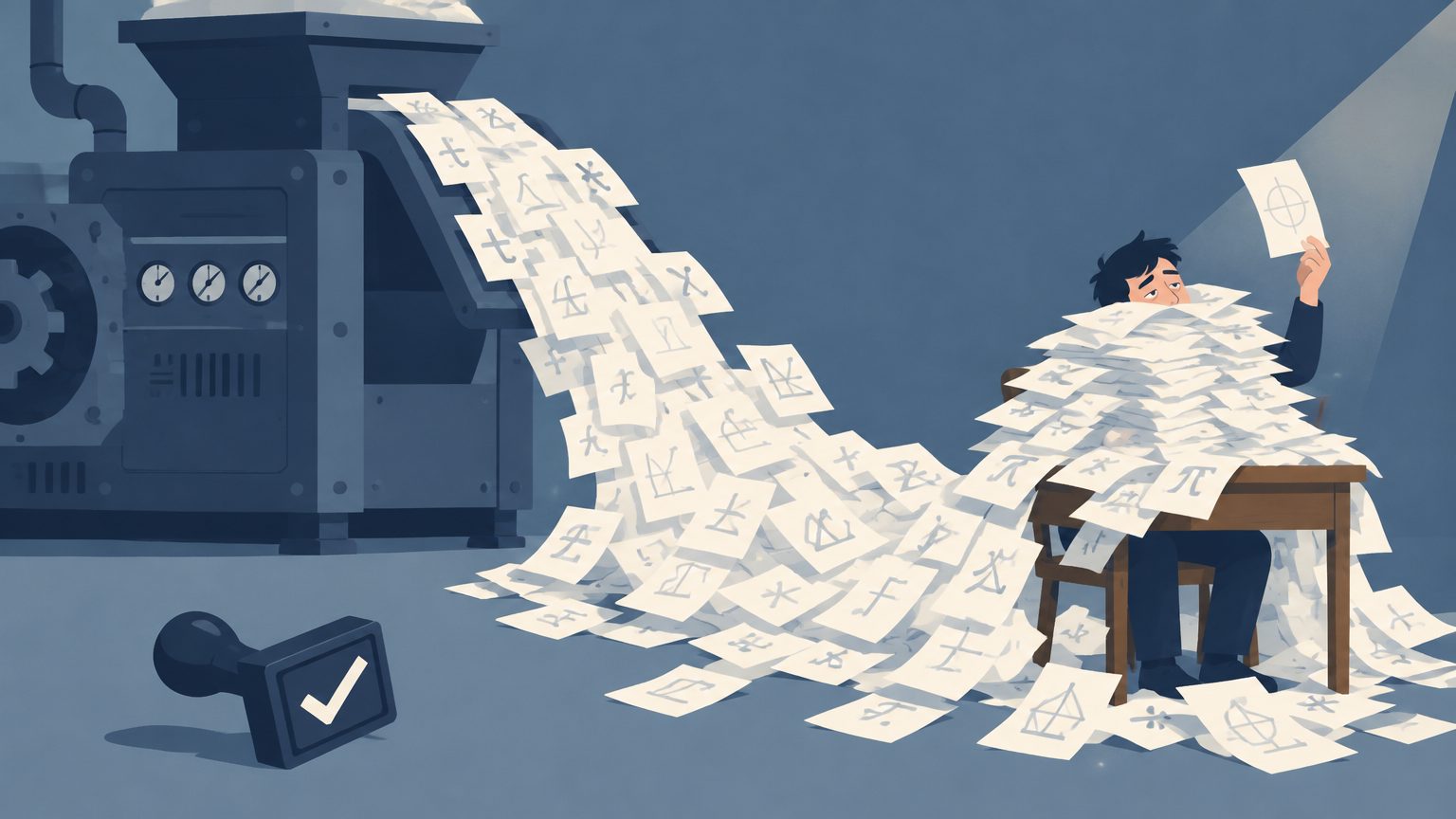
- OpenAI's three Oct 26 results got three levels of check: Sogge is Lean-formalized, the ETH disproof is Lean-verified and shepherded by named experts, Yang-Mills is withheld until a Nobel-led group reports.
- The catalog of the whole release marks no status per paper, and The Atlantic reports that some papers appear not to prove what they claim.
- On this record mathematicians are not replaced: Tao's complaint is that machines skip the explaining and judging, and the Simons Foundation is already putting $15M into evaluation, $5M of it from OpenAI.
On Oct 6, OpenAI put 722 mathematics manuscripts online, and only one of them had a human edit before release. Terence Tao calls the result proof indigestion: more AI-written mathematics than the people who must judge it can absorb. Whether those manuscripts are proofs is the part nobody has settled, and it makes who checks the checker a sharper question than whether mathematicians get replaced. Three results OpenAI announced on Oct 26 show how unevenly that checking is going.
The Oct 6 release shared some Lean files but gave no status for each paper
On Oct 6, OpenAI published 722 manuscripts covering 372 result families in a public GitHub repo, written by an unreleased internal model. The claims reach from Khot's unique games conjecture, an open problem in theoretical computer science, to the quasi-Riemann hypothesis, a weaker version of the Riemann hypothesis. The announcement post names no result's check status: it says formalizations of many of the proofs are shared in Lean, and promises more as they are obtained.
The 41-page catalog of the manuscripts marks no verification status for any entry. The later announcement posts name checks only for their headline results. As far as the public record shows, most of the 372 families have no stated check.
One headline can hide two different check states, and quasi-Riemann is the example. The real Riemann hypothesis says that a set of special numbers, the nontrivial zeros of the zeta function, sits exactly on one line. Quasi-Riemann weakens that to a strip around the line, and the narrower the strip, the stronger the claim. The first version, dated Sept 30, squeezes the zeros between 1/8 and 7/8 and is formally verified in Lean. The second, finished almost a week later, claims only the wider strip between 1/12 and 11/12 and is not formally verified.
The three Oct 26 results arrived with three different levels of check
On Oct 26, OpenAI announced three further discoveries. SCMP's Nov 3 story placed them in the current week, but the post is dated Oct 26. The useful part is how each one was checked:
| Result | What it claims | Who has checked it |
|---|---|---|
| Sogge local smoothing | A proof of Sogge's local smoothing conjecture, which describes how waves focus and fade, in every dimension of at least 2; it also resolves the Kakeya and Stein restriction conjectures. AI output Oct 18. | A machine: Lean-formalized Oct 19 and released. |
| ETH disproof | A disproof of the Exponential Time Hypothesis for 3-SAT. Found Oct 16. | A machine and named experts: Lean-verified Oct 17, shepherded by the hypothesis's original proposers Impagliazzo and Paturi plus Ryan Williams. |
| Yang-Mills and QCD existence | Existence proofs for interacting quantum field theories in 4D, including QCD, the theory of the strong nuclear force. | Nobody outside OpenAI yet: a Lean formalization was finished Oct 16, but the artifacts are withheld pending review by a group led by Nobel laureate David Gross. |
Lean is a proof assistant that checks every step of a proof against the claim as stated. It guarantees that the steps follow. It does not judge whether the stated claim says what the mathematician wanted.
That makes the checker a chain. Lean checks the steps, named experts check that the formal statement is the real conjecture, and for most of the 372 families nobody has published either check.
That second check is done by people, and the table shows who. For Sogge, no independent human re-check of the formalization has been named. The ETH disproof was shepherded by the conjecture's own proposers, who are positioned to confirm that the formal statement is the real conjecture. The Oct 26 post also says the ETH shepherd group got OpenAI to commit to funding a conference where the community can examine the ETH claim in the open.
The Yang-Mills row is also narrower than it sounds. Existence of the theory is the weaker half of the Clay Millennium problem; the mass gap, its harder half, is not claimed.
Nobody has published how many of the 372 families hold up
OpenAI's own count, relayed by the Computational Complexity blog on Oct 18, has the model attempting about 4,000 problems and reporting results for 372 families, some full and some partial. None of the sources we read says how many of the 372 survive a careful reading.
The sourced limit so far is quality. Several mathematicians told The Atlantic that some of the papers appear not to prove what they claim to prove, which is why a person or a Lean check still has to go through each one.
The release also has defenders. Stanford's Jared Duker Lichtman told Quanta on Oct 19 that he considers the quasi-Riemann proof the most significant AI-for-math achievement so far. That is an expert's opinion, which verifies nothing by itself, and the second quasi-Riemann version remains unverified.
The reading job is the part nobody has priced. As a back-of-envelope with the assumption in plain view: at two hours per manuscript, a skim-and-trust rate that understates real verification time, 722 manuscripts come to about 1,444 hours, roughly 36 working weeks for one reviewer.
Tao's war footing
The release landed on a field already uneasy about how AI mathematics gets absorbed. On Sept 11, 25 Fields Medalists wrote a joint letter asking that AI-found solutions be developed and integrated by humans. They objected that famous problems were being treated as benchmarks while the human work of developing, explaining and teaching results gets skipped, and that shortcuts undermine how the subject is passed down and how students learn (Straits Times). Then October landed 722 papers on the field in one day.
Tao told the New York Times on Oct 16: "I'm on a war footing."
In Nature on Oct 22 he gave the diagnosis its name: the release disrupted countless research programmes overnight, and the problem is proof indigestion, more output than the field can absorb.
He explained the cause to The Observer: maths problems are nearly the last tests modern AI systems can still fail, so the field's open questions have become training benchmarks and the proofs are a byproduct. "Great results, but they don't care how elegant the solutions are, or who understands them, or what to do next." He does not call for a ban; he wants the field to shift credit away from bare solutions and toward explanations and understanding.
The cost appeared within weeks. On Oct 28, in a New Scientist video interview about an earlier OpenAI announcement of a result on the Navier-Stokes fluid equations, separate from the Oct 6 release, Tao said the community had learned almost nothing mathematically from it. "It's like strip-mining the landscape," he said. The area around the problem, which had been very active, had fallen into what he described as disarray. His curated page makes the same comparison in print: automated strip-mining of open problems is like excavators digging treasures out of an archaeological site.
Review money is arriving, and $5M of it is OpenAI's
The Simons Foundation launched a $15M effort to help mathematicians evaluate AI output, and $5M of it comes from OpenAI.
DeepMind's AlphaProof Nexus (Science, Oct 8) shows what a published check looks like. It resolved dozens of open problems, all machine-checked, and published the checks alongside the results. The Oct 6 release shares Lean files for many proofs, but it has no uniform published check across its 722 manuscripts, and its catalog gives no per-paper status.
What to watch next
Two events would move this story. The first is the report of the Gross-led review group on Yang-Mills, the only scheduled outside check on the least-verified of the three Oct 26 results; none of the announcements names a date. The second is a machine check for the wider-strip quasi-Riemann version, which would put both versions under the same headline on equal footing.
Try this: next time a headline says an AI proved a famous problem, open the primary post and look for three things: a Lean status, a named group that reviewed the result, and released files you can inspect. Then check the claim's scope, because a weaker version or a narrower claim can sit under the same headline.
Will mathematicians be replaced? Not on this record
SCMP's headline asked whether mathematicians face an uncertain future. On this record, the work that grew in October is judging whether a result is the right one, and that is still done by people. The record shows the model producing results at machine speed. It shows no choosing of which statements matter, no explaining of a result so people can use it, and no judging of how far it reaches. Tao's version is that the systems do not care "who understands them, or what to do next", and the 25 Fields Medalists asked that humans keep the explaining and teaching. Of the three Oct 26 results, only the ETH disproof has named experts positioned to confirm that its formal statement is the real conjecture.
Until each of the 722 manuscripts carries a published check, a reader has to take its result on faith or do the checking themselves. The bottleneck in mathematics has moved from producing proof-shaped manuscripts to establishing that they are proofs.
Sources
Sourcing note: counts and dates come from OpenAI's two posts, checked against press coverage on Nov 5; the Computational Complexity post was read from its own URL on Nov 9. OpenAI's catalog now lists 373 families in 721 manuscripts and some outlets count 377 individual results, so totals vary slightly. We did not read the 722 manuscripts themselves.
- OpenAI (Oct 6): Sharing AI progress in mathematics, the 722 manuscripts and 372 families
- OpenAI (Oct 26): Building scientific understanding, the three further discoveries, their statuses, and the ETH conference commitment
- OpenAI repo catalog: overview.pdf, 41 pages, no verification status marked
- Quanta (Oct 19): AI proved the quasi-Riemann hypothesis, Lichtman's assessment and the two versions
- The Atlantic (Oct 8): OpenAI math proofs, papers that appear not to prove their claims
- Computational Complexity blog (Oct 18): AI, Math, the document-drop. Non-Tech Thoughts, about 4,000 attempts and 372 families, OpenAI's count as relayed by Gasarch
- NYT (Oct 16): Terence Tao on AI, the war footing quote
- Nature (Oct 22): Tao's World View, research programmes disrupted, proof indigestion
- The Observer (Oct 23): Tao interview, benchmarks, byproducts, and what he wants rewarded
- New Scientist (Oct 28): Terence Tao: AI is outrunning our ability to control it, video interview, the strip-mining line and the disarray around Navier-Stokes; Tao's curated page for the excavator comparison
- Straits Times (Oct 19): Why one of the world's greatest mathematicians is on a war footing, the Fields Medalists letter
- Science (Oct 8): AlphaProof Nexus, results published with Lean verification
- Simons Foundation (Oct 2026): $15M effort, evaluating AI output
- SCMP (Nov 3): AI solves maths puzzles faster than humans, the this-week dating error
More from the site: What Is Weight-Space Programming? AI Edits Model Weights: the same autumn's other frontier: one AI model editing another model's weights directly (Nov 3) The AI off-switch is not a plan: two formal results on who controls a capable machine, and when (Nov 2)